ARCHITECTURE

This study presents a quantitative analysis of the Macau Peninsula’s road network (China) and the accessibility of its urban parks using Space Syntax methods, based on three key indicators: global integration, local integration, and attractiveness density. The findings indicate that urban parks in the central part of the Macau Peninsula exhibit relatively high global integration values. Furthermore, parks located near the historical center generally demonstrate high levels of accessibility. Urban parks with high local integration feature a clear internal path network and are saturated with diverse landscape nodes. Conversely, low local integration in other parks is attributed to internal path constrains caused by the terrain and the specific ways these parks connect to the surrounding street network. An analysis of attractiveness density reveals, that under the influence of varying cultural contexts, urban parks are integrated within highly diverse urban fabric. At the same time, the analysis of the internal structure of urban parks in Macau reveals that their landscape structure is a complex system consisting of three components: material form, behavioral functions, and cultural semantics. An optimization strategy for these parks, based on an "axial planning – transport configuration – rethinking value structure" model, has been developed to enhance their overall landscape value.
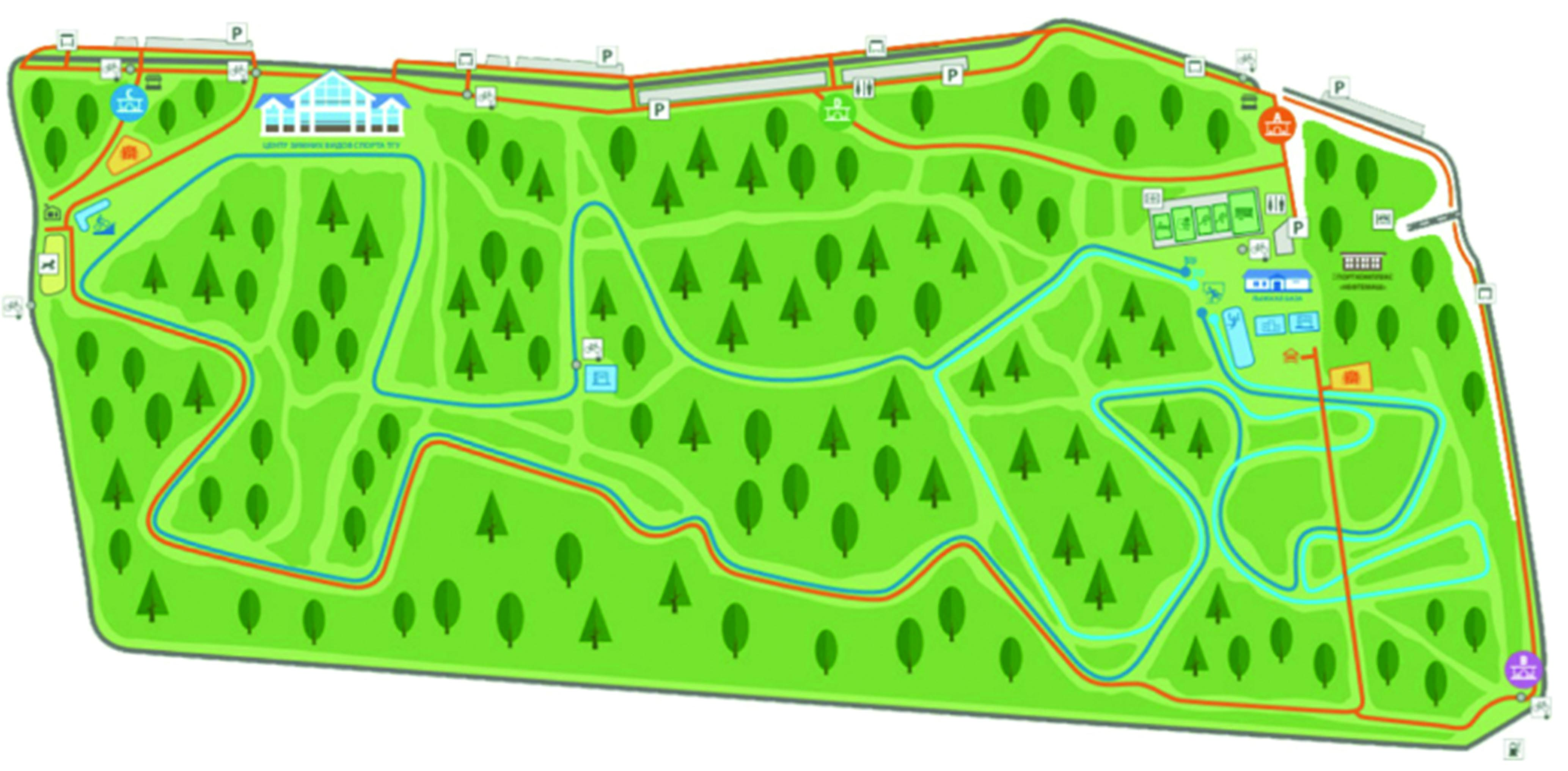
The creation of a comfortable and accessible urban environment tailored to low-mobility population groups, alongside the development of parks and gardens as elements of green rehabilitation, is highly relevant today. This research employs a comprehensive approach, including a field survey using the example of the Zatyumenskiy Ecopark (Tyumen), an assessment of the accessibility of forest-park areas based on main criteria using a five-point scale, and a sociological survey of 125 respondents representing key user groups among the low-mobility population groups. The field survey results revealed a mixed picture: the average accessibility score was 3.8, highlighting both strengths (transport accessibility and lighting) and critical deficiencies (a lack of inclusive and service infrastructure). The sociological survey data confirmed the existence of persistent barriers that limit the duration and comfort of stay for low-mobility groups within the ecopark. The theoretical and methodological basis of the study is a synthesis of Attention Restoration Theory, Stress Recovery Theory, and the principles of ecotherapy. Based on the identified contradiction between the territory’s high natural rehabilitation potential and its low level of infrastructural adaptation, this study formulates principles and design proposals for the landscape transformation of the ecopark.These include the formation of a continuous, barrier-free path network, the creation of a sensory rehabilitation route, the development of adapted recreation zones and therapeutic sites, and the introduction of an inclusive navigation system and service infrastructure. The findings can be applied to the design, adaptation, and development of similar recreational areas.
CONSTRUCTION

This article addresses issues encountered during the analysis of the Strength Reduction Method (SRM) employed for assessing the stability of soil slopes. The FEA computer program was used as a research tool. Within this program, a method has been formalized for constructing the most probable sliding line and calculating the stability margin coefficient, based on an analysis of the stressed state in soil mass (V. K. Tsvetkov, 1977, 1979). It has been demonstrated, that the calculation results are significantly influenced by the dimensions of the calculation schemes within the finite element method and their degree of discretization. Holding all other factor constant, the numerical values of stresses and displacements at points within the studied area depend significantly on these parameters. Furthermore, changes (increase or decrease) in the numerical values of the constituent soil’s physical and mechanical properties (cohesion and angle of internal friction) lead to changes in the stiffness of the investigated mass. This, in turn, affects the numerical values of the lateral pressure coefficient and the deformation modulus, which further impacts the stress-strain state of the near-slope area and, consequently, the final result. Neglecting these factors affects the reliability of results obtained using numerical analysis methods for the stress-strain state of a soil mass, including SRM. Current computational software does not incorporate procedures to mitigate the influence of the aforementioned factors. Therefore, it is necessary to investigate the degree of their influence on the result and, if required, to develop procedures for this mitigation.

The purpose of this study is to compare approaches to the quantitative probabilistic assessment of homogeneous slope stability using Monte Carlo method, employing standard engineering software and advanced statistical analysis. Additionally, it aims to assess the impact of the chosen distribution laws on the final calculation of the probability of collapse.
Methods. The GeoStudio software package served as a primary tool for deterministic and probabilistic calculation of the stability factor FS using four methods: Fellenius, Bishop, Janbu, and Morgenstern – Price. For in-depth analysis, the Morgenstern – Price method was implemented using the @RISK add-in for MS Excel. Statistical processing of the results and identification of distribution laws were performed using the R Package (fitdistrplus package), and using the Cullen – Frey skewness – kurtosis plot.
Results. Statistical analysis of the empirical stability coefficient distribution revealed its positive skewness and proximity to exponential-type distributions (e. g., Weibull, gamma). Approximating the data with the Weibull distribution results in a collapse probability value 33.8 times higher than the estimate obtained assuming a normal distribution FS.
Conclusions. Standard engineering software offers a limited range of functions for adequate probabilistic analysis. Without additional statistical validation, their use can lead to a gross underestimation of the risk due to an unsubstantiated assumption of a normal distribution law for the stability factor. For an accurate assessment of collapse probability, it is essential to identify the empirical distribution of the stability factor using specialized statistical tools. When modeling slope stability, it is recommended to consider skewness distributions, such as the Weibull or lognormal distributions.
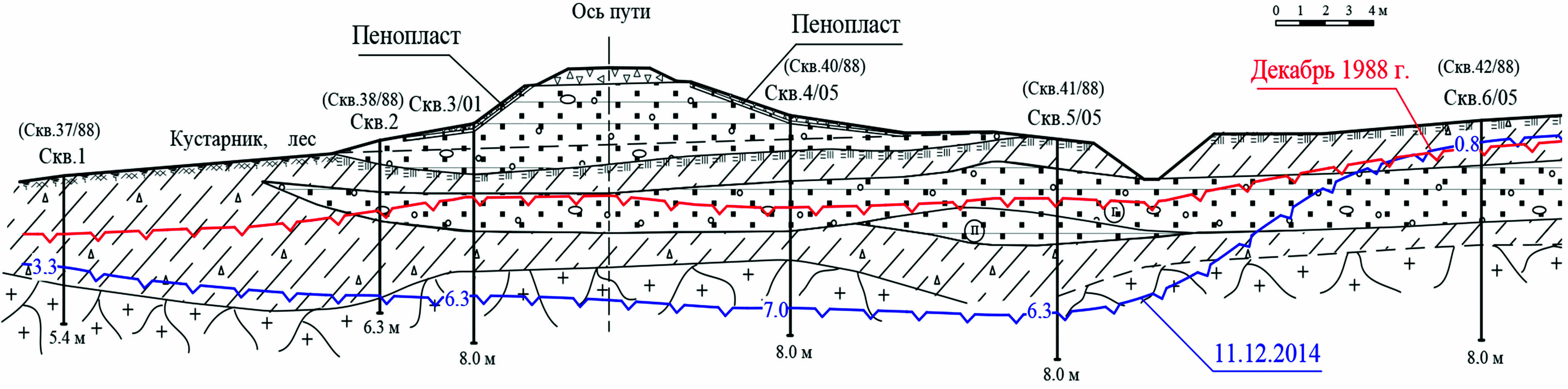
Persistent temperatures increasers in Arctic regions, particularly near coastal infrastructure, are causing permafrost thaw and significantly increasing operational risks. The reduction in foundation bearing capacity with even a slight soil temperature increase of a few degrees Celsius is particularly dangerous, potentially leading to deformations and accidents. Research indicates that an increase from –3 to –0.3 °C in permafrost temperature can reduce pile bearing capacity fivefold. This underscores the necessity for development and implementing preventive measures to reinforce the foundations of buildings and structures in permafrost zones. Analysis of historical data, including average annual temperatures from various weather stations, revealed that global warming in the Northern region commenced in the mid-1970s. From 2015 to 2025, average annual temperatures have risen to record levels. In addition to rising temperatures, there has been an increase in the amount and intensity of precipitation, particularly snowfall, leading to increased snow cover and posing challenges to the operation of transport and infrastructure systems. An analysis of construction and technological solutions historically applied to transport infrastructure in permafrost zones has revealed a need for new technologies and adaptive measures to ensure the safe operation of infrastructure amidst accelerating Arctic climate change.
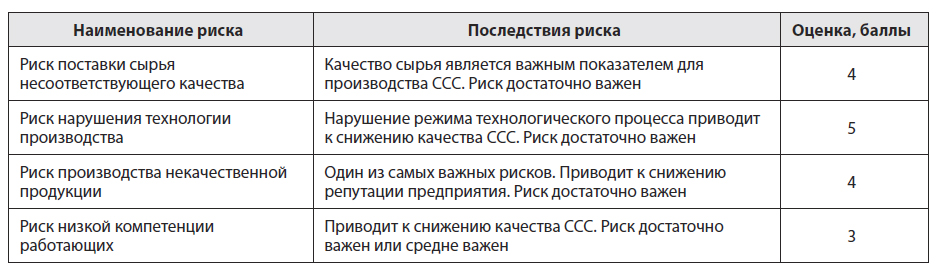
Technological risks during the production of dry building mixtures can lead to product defects. The purpose of this article is to assess and manage these risks to reduce the defect rate of finished products. We examine the influence of raw material quality and the state of the technological production process on the probability of defects. Dry mixtures CemPLAST, Bundes Koroed B2, and Bundes Koroed C3 from the New MIX company (Penza) were analyzed, using various raw materials: Sengileyevskiy CEM I 42.5B and Haldenberg CEM I 42.5N cement. It was established, that using cement with lower variability in its activity index in the formulation contributes to reducing the risk of defective dry building mixtures. The quality assurance of dry mixtures with varying ratios of the mean square deviation within the tolerance field was demonstrated. The values for producer and consumer risks were calculated based on the technological process state during the production of dry building mixtures. For unstable and non-reproducible processes, these risks accounted for 0.195847 and 0.139404, respectively. A risk assessment map for the production of dry building mixtures was developed. Each stage of the production process was analyzed in terms of risk probability and severity of consequences (assessed on a five-point scale). Risk levels were calculated, and risk management measures were proposed. It was determined that the highest severity of consequences is associated with raw material acceptance (high – 4 points), dosing (critical – 5 points), and component mixing (high – 4 points). The quantitative assessment of risk levels for these stages ranged from 8 to 10, indicating an average level.
TRANSPORT
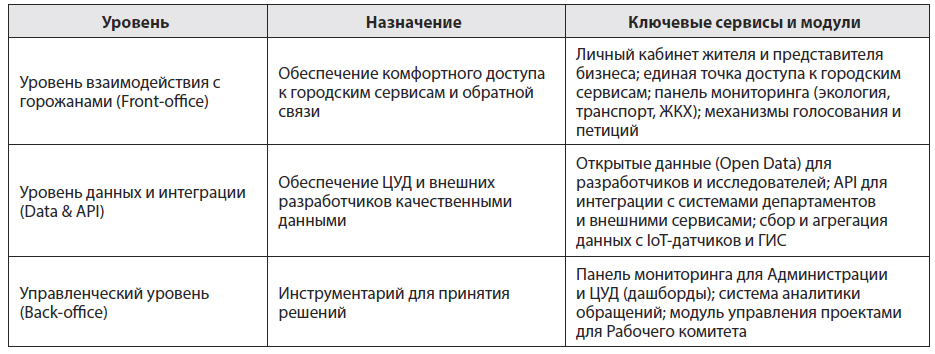
Digital transformation in cities is a priority that is currently evaluated through digital maturity ratings. However, existing approaches remain fragmented and lack a unified management framework, which hinders the achievement of top rankings. Based on a systems approach, scenario planning, and organizational design, this article develops an organizational and management model anchored in Data-Driven Governance principles. The study analyzes the current standing of the city of Tyumen within the federal ratings established by the Ministry of Digital Development, Communications and Mass Media and the Ministry of Construction, Housing and Utilities of the Russian Federation. Furthermore, it proposes a three-level management architecture that integrates a Strategic Council (for goals and KPIs), a Data Management Center (for analytics), and a Working Committee (for project implementation). The architecture for the unified city portal "Smart City Tyumen" was designed as the core of a digital ecosystem for data collection, citizen feedback, and service integration. Within this model, the Industrial University of Tyumen is identified as a center of expertise, a provider of human resources, and a platform for pilot testing. The proposed model demonstrates a shift from fragmented technological solutions toward an integrated, self-learning management system with potential for scalability across other municipalities. This model provides the basis for the systematic management of a city's digital transformation and the achievement of target indicators in federal ratings.

ISSN 2713-0770 (Online)